Create a maximum-ambition Three.js experience of one fixed stretch of the Thames riverbank in London, watched from the same camera position across two thousand years, driven by one grand time slider. Every position of the slider is a complete, living, richly detailed world; dragging it morphs the city through history: Roman Londinium's timber wharf, the medieval city crammed onto Old London Bridge, the Great Fire glowing at night, the Victorian forest of masts and steam, the Blitz's searchlights, and today's glass skyline. This must not be a slideshow of static dioramas, a fade between five images, or a sparse stage set. It is one continuous place breathing across centuries, with the river as the only constant.

The goal is the visual impression of a billion individually considered pieces in EVERY era: timber joints, rigging, brick chimneys, market stalls, cranes, buses, and thousands of inhabitants living each period. Achieve it with instancing, era-streaming and nested LOD, not raw counts.

If you use Three.js, add an import map before the module script mapping "three" and "three/addons/" to the same pinned version, and import only via those names. Everything procedural; no external assets.

#### FIRST FRAME - TODAY, THEN THE SLIDER
- Open on the present day, fully alive: the river bend with a recognizable modern composition (a great bridge, the dome of St Paul's holding its ancient ground among glass towers), boats, buses, crowds on the embankment, afternoon light on the water.
- The time slider is immediately visible as an elegant timeline along the bottom, marked with era labels and small icons. It is the single hero control and invites dragging within seconds.
- No menus, titles or reveals; the present-day world must already reward exploration before the slider is touched.

#### THE ERAS - SIX COMPLETE WORLDS
- Roman, around AD 100: timber quay and warehouses, a bridge of boats or early timber bridge, red-roofed bathhouse and forum on the low hill, galleys unloading amphorae, legionaries, mud, smoke, geese.
- Medieval, around 1400: Old London Bridge crowded with tall houses and its chapel, water wheels roaring between the piers, church spires beyond, timber-framed riverfront, ferrymen, markets, laundry, pigs in lanes.
- The Great Fire, September 1666, night: the city alight upriver, a wall of orange glow and sparks against the dark, silhouetted fleeing boats loaded with belongings, firelight dancing on the water, St Paul's (old, gothic) burning on the skyline. Terrifying and beautiful, but rendered bright and readable, never murky.
- Victorian, around 1850: a forest of masts and steam funnels, warehouses with cranes swinging cargo, the new stone bridges, horse traffic, gaslights, coal smoke haze golden in low sun, mudlarks on the foreshore.
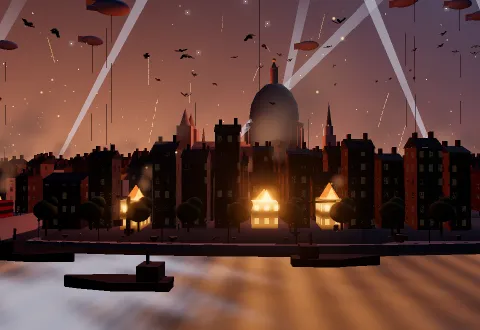
- The Blitz, 1940, night: searchlight beams sweeping, barrage balloons silver overhead, the skyline dark except for fire glows and the famous silhouette of St Paul's dome standing amid smoke, tracer arcs distant, river reflecting it all. Handle with grandeur and restraint - no gore, the drama is light and survival.
- Today: the same bend with its modern icons, tour boats, joggers, buskers, glass towers, the surviving old buildings visibly the same structures the viewer watched exist in earlier eras.

#### CONTINUITY IS THE MAGIC
- Anchor objects must persist and visibly evolve so the morphing feels like one place aging: the river bend and foreshore; one church that grows from stone chapel to gothic spire to Wren dome; one street line that never moves; a corner tavern that is a Roman inn, a medieval alehouse, a Victorian pub and a modern pub with the same footprint.
- When the slider moves, buildings must not simply crossfade: they grow, are re-clad, burn, are rebuilt - staged as fast, readable transformations with scaffolding-free elegance (rising from footprints, roofs assembling, styles re-skinning) so scrubbing back and forth is itself a spectacle.
- The river always flows; boats of the correct era always move on it; birds persist across all time.

#### EVERY ERA FULLY ALIVE
- Each era carries its own autonomous population with correct dress, vehicles and routines: unloading, trading, fleeing, promenading, commuting. Density comparable to the best living-city scenes, never a sparse stage.
- Each era has signature motion: Roman oars and cranes, medieval water wheels, 1666 flames and ember drift, Victorian steam and swinging cargo, Blitz searchlights and balloons, modern traffic and rowing eights.
- Sound-free visual storytelling: readable vignettes in every era rewarding zoom (a Roman merchant arguing over an amphora, a 1666 family loading a boat with a birdcage, a Victorian crane lowering a piano, a modern couple photographing the same view the viewer occupies).

#### LIGHT AND MATERIAL
- Each era gets a distinct, gorgeous lighting signature as listed above; transitions in time also transition light smoothly (scrubbing from 1850 afternoon into 1940 night is a cinematic event).
- Materials evolve honestly: timber, wattle, stone, brick, iron, concrete, glass - weathered and believable at close range in every period.

#### EXPLORATION AND CONTROLS
- The camera holds one privileged bankside position by default but supports orbit, pan and zoom within a generous bubble, plus presets: foreshore level, bridge level, rooftop level, and a high aerial that makes each era's full extent readable.
- The time slider supports both snapping to era labels and free scrubbing between them with interpolated transformation states.
- Compact secondary controls only: activity density, a small "era facts" toggle OFF by default, photo mode.

#### PERFORMANCE
- Stream era content intelligently: the active era at full fidelity, adjacent eras pre-warmed for instant scrubbing, distant eras unloaded; shared geology, river and anchor objects always resident.
- Instanced crowds, boats, buildings and props per era; merged distant skylines; LOD discipline throughout.
- Quality selector reduces population and far detail before ever sacrificing transformation smoothness or era completeness.
- Smooth on a modern laptop, devicePixelRatio clamped to 2. The outcome: two thousand years of one riverbank, held in the hand.
Prompt collected by petergpt (collection) ; the original author is unknown on GitHub. github.com/petergpt/3d-prompt-collection/blob/HEAD/README.md#prompt-04 . Copies include this credit. 
 One Riverbank Across Agespetergpt (collection) · Cinematic animations