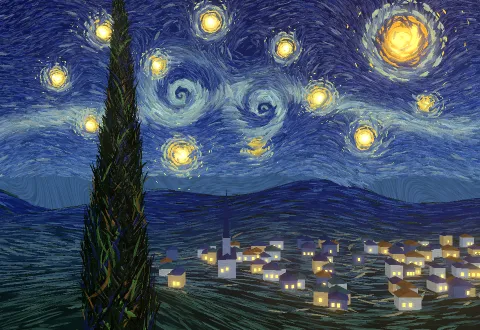
Create a maximum-ambition Three.js experience of Van Gogh's The Starry Night in which the painting is only the first frame of an infinite painted universe. The experience opens as a pixel-faithful reproduction of the most famous night sky in art - and the first camera movement shatters the flatness: the sky has depth, the swirls are three-dimensional rivers of moving paint, and the viewer can fly off the hillside INTO the sky, deeper and deeper, without ever reaching an end. This must not be a textured skybox, a flat shader wobble, a diorama of the village with a static painted backdrop, or a particle screensaver. It is the discovery that the painting continues inward forever.

The goal is the visual impression of a billion living brushstrokes: every stroke an individual three-dimensional ribbon of thick paint with direction, body and glow, all of them in perpetual motion. Achieve this with instanced stroke geometry driven by flow fields, not with static textures.

If you use Three.js, add an import map before the module script mapping "three" and "three/addons/" to the same pinned version, and import only via those names. Everything procedural; no external images or models.

#### FIRST FRAME - THE PAINTING, EXACTLY
- Open with the camera positioned so the scene reproduces The Starry Night's exact composition, edge to edge: the great flame-shaped cypress dark on the left, the sleeping village with its pointed steeple below, the rolling blue hills, the eleven radiant stars, the crescent moon burning orange in the upper right, and the vast double-spiral swirl commanding the center of the sky.
- Palette fidelity is non-negotiable: deep ultramarine and cobalt night, chrome yellow and ochre star halos, the pale turquoise ribbon of the sky rivers, blacks-greens of the cypress, warm lamplight in the village windows. Any drift toward generic navy-and-white space art is failure.
- The image must hold for a breath as a convincing painting - visible impasto ridges, stroke direction following Van Gogh's actual rhythms (horizontal weave in the sky rivers, licking verticals in the cypress, shingled dabs on the hills).
- The instant the viewer moves the mouse, parallax reveals the truth: strokes at different depths slide against each other. No menus, titles, overlays or instructions - the discovery IS the opening.

#### THE SKY AS LIVING PAINT - DYNAMISM IS THE SOUL
- Build the sky from hundreds of thousands of instanced brushstroke ribbons: curved, tapered, thick-edged strips with painted-color gradients and subtle emissive glow, oriented and advected along a great curl-noise flow field shaped to Van Gogh's actual swirl composition.
- The entire sky flows perpetually, at the pace of slow water: the double spiral turns over tens of seconds, sky rivers stream between the stars, strokes are continuously carried along the field and recycled invisibly so the composition never dissolves - the painting is the equilibrium the motion lives inside.
- Stars are the second motion system: each of the eleven stars and the moon is a blazing core wrapped in concentric orbiting halo strokes that pulse gently, shed drifting flecks of yellow paint, and visibly stir the flow field around them like heat above a fire.
- Nothing in the sky may ever be static. A paused frame should still look exactly like the painting; thirty seconds of watching should feel like standing inside slow luminous weather.

#### THE FLIGHT INWARD - THE PAINTING IS INFINITE
- The core mind-blow: the viewer can leave the hillside and fly INTO the sky. Scrolling or flying forward passes through the first stroke layers - ribbons of paint sliding past the camera close enough to read their bristle grooves - and reveals that the swirl continues inward: larger structures resolve out of the deep, new spirals behind the first, star systems of paint further back, rivers of turquoise flowing between them.
- Implement genuinely deep layering: procedurally generated swirl and star structures continuing for many nested depth shells, each shell consistent with the painting's palette and stroke language, streaming in ahead of the camera and released behind it so the flight can continue indefinitely in any direction into the sky.
- Depth must be felt: parallax between stroke layers, stars passing beside the camera like burning wheels, occasional colossal swirls the size of the whole original painting drifting past in the far deep, atmosphere hazing distant structures toward deep ultramarine.
- Flying is effortless and beautiful: smooth inertial flight toward the look direction, slow default drift if hands-off, one reset that returns to the exact painting composition from frame one - the return to flatness after deep flight is itself a wow.

#### THE VILLAGE AND EARTH BELOW - THE QUIET COUNTERWEIGHT
- The village is fully built, not a backdrop: tiled roofs as shingled stroke-dabs, the church steeple, glowing amber windows with individual warm flickers, lanes, hedgerows, the rolling hills in layered stroke-waves, distant blue mountains.
- The cypress is a hero object: a three-dimensional tower of writhing black-green flame strokes, its tips genuinely licking and swaying in slow motion, close enough to fly around and through.
- The earth breathes too: wind visibly travels across the wheat and hills as waves of stroke re-orientation, chimney smoke rises in curling painted threads, window lights flicker, the hills' strokes shimmer as cloud shadows from the sky pass over them.
- Looking BACK down at the village from deep inside the sky - the little glowing town far below beneath the churning painted cosmos - must be a composed, breathtaking view; tune the scale relationship deliberately for it.

#### MATERIAL TRUTH - IMPASTO OR NOTHING
- Strokes are paint, not light: thick ribbon geometry with ridge highlights along their edges, matte body color, subtle emissive only where Van Gogh used his brightest pigment (star cores, moon, windows). Specular glints crawl along impasto ridges as the camera moves.
- Close approach must survive: a single stroke filling the screen should read as a believable trowel of oil paint - directional bristle grooves, slight color marbling, torn edges.
- Background between strokes is never empty black: deep layered underpainting tones so every gap reads as painted canvas depth, not void.

#### EXPLORATION AND CONTROLS
- Immediate free flight plus orbit fallback; reset to the exact painting view. Presets: the painting composition; among the village rooftops looking up; circling the cypress crown; alongside the moon; deep-sky looking back at the village; inside the heart of the great spiral.
- Compact controls only: flow intensity (becalmed / Van Gogh / storm), flight speed, and photo mode. Nothing else - the painting does not need a UI.

#### PERFORMANCE
- Instanced stroke rendering throughout with aggressive frustum and depth-shell management; nearest strokes full ribbon geometry, mid-field simplified ribbons, deep field as oriented stroke sprites that are visually indistinguishable at their distance.
- Quality selector reduces stroke counts and shell depth before ever sacrificing palette fidelity, flow motion or first-frame accuracy.
- Smooth on a modern laptop, devicePixelRatio clamped to 2. The outcome: the most famous sky in art, finally deep enough to fly into.
Prompt collected by petergpt (collection) ; the original author is unknown on GitHub. github.com/petergpt/3d-prompt-collection/blob/HEAD/README.md#prompt-45 . Copies include this credit. 
 Fly Into a Painted Nightpetergpt (collection) · Cinematic animations